Research & Resources

My passion is helping educational leaders solve real problems of practice—work grounded in continuous improvement, a collaborative culture, and a deep commitment to equity. I focus on what I call the vision–implementation gap, which is the disconnect between a leader’s improvement vision and the leadership moves that bring it to life in schools and districts. By supporting user-centered, problem-specific inquiry, I aim to help leaders build the collaborative routines and workplace conditions needed to turn bold, equity-focused ideas into coherent, systems-level change.
Selected Publications
Featured Book
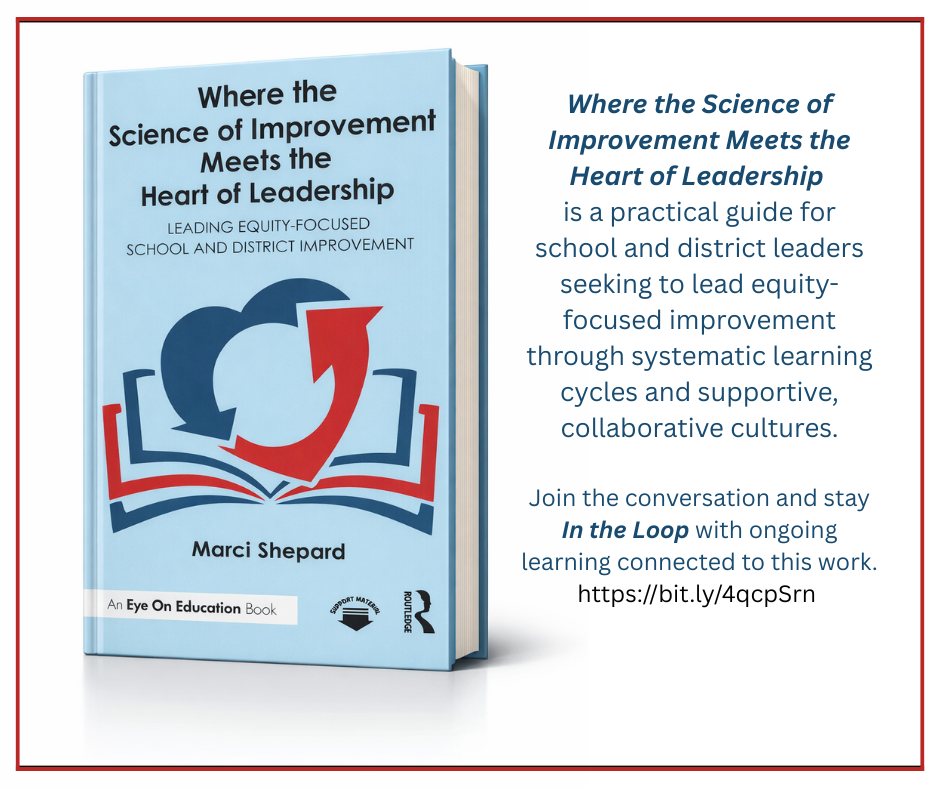
Shepard, M. (2026). Where the science of improvement meets the heart of leadership: Leading equity-focused school and district improvement. Routledge.
Published
Mettler, M., Wolfe, A., Shepard, M., Dunning, D., Francis, J., Flamm-Miller, M., & Suwannasing, K. (2024). The Child Development Associate (CDA) as a Viable Steppingstone in the Early Childhood Education Classroom. Journal for Research and Practice in College Teaching, 9(2).
Perlman, H., Rubin, E., Shepard, M., & Bohannon, A. (2024). Continuous Improvement Practices to Promote Equity: A Meta-Synthesis of Research. Review of Research in Education.
Shepard, M. (2022). Profiles and Lived Experiences of Superintendents Using Improvement Science. [Doctoral dissertation, Purdue University].
Shepard, M. (2019). Strategies School Districts Can Use to Develop Life-Ready Students. WSASCD Critical Question Series.
Shepard, M. (2014). Supporting the Professional Growth of Central Office Leaders. School Information and Research Service, 12(1&2), 13–15.
Shepard, M. (2008). From a Culture of Isolation to Collegiality: Professional Development Using Evidence of Student Learning to Increase Teacher Efficacy and Student Learning. [Doctoral dissertation, Walden University]. Dissertation Abstracts International, 69A(10).
Resources
The following practice resources accompany the book Where the Science of Improvement Meets the Heart of Leadership and are designed to support educational leaders in applying improvement science in real-world systems.
This support material—referred to as Try This—are intended for individual reflection, leadership team learning, and networked improvement efforts.
- Preface – Try This: Where Are You on Your Improvement Journey? (This self-assessment will help you determine your school or district’s current strengths and areas for growth in using improvement science for equity-centered continuous improvement.)
- Chapter 1 – Try This: Build a Workplace Culture for Continuous Improvement (A strong workplace culture is the foundation for continuous improvement. This activity will help you reflect on your current culture and consider the possibilities of using improvement science to help your school or district keep getting better.)
- Chapter 2 – Try This: Identify Your Leadership Values (This activity helps leaders clarify their core leadership values and reflect on how those values show up in daily decisions, behaviors, and improvement efforts.)
- Chapter 3 – Try This: Apply Deming’s PDSA Cycle to Your Own Leadership Practice (It is helpful to try something yourself before you lead others in doing it. This tool is designed to help school and district leaders apply the Plan-Do-Study-Act (PDSA) cycle to improve a specific, personal leadership practice.
- Chapter 4 – Try This: Apply the Six Principles of Improvement (This tool helps school and district leaders assess, reflect, and align their current improvement efforts with the Six Principles of Improvement to drive meaningful, sustainable change.)
- Chapter 5 – Try This: Apply the Six Leadership Paradigm Shifts (Use this tool to reflect on your leadership mental models and develop actionable steps for using the six paradigm shifts to frame your work. For each shift, consider how the mindset is reflected in your practice, identify barriers, and plan a next step to move the disposition forward.)
- Chapter 6 – Try This: Tools that Support Disciplined Inquiry (Appendix 2) (The tools mentioned throughout this chapter support the Carnegie Foundation for the Advancement of Teaching (2018) 5-phases of the inquiry process.)
- 2.1 Assemble a Team Check-In
- Phase 1: Understand the Problem and the System that Produces It
- 2.2 Identify an Issue
- 2.3 Data Analysis Protocol
- 2.4 5 Whys Protocol
- 2.5 Fishbone Diagram
- 2.6 Process Mapping
- 2.7 Empathy Interviews
- 2.8 Research and Evidence to Understand the Problem
- 2.9 Affinity Protocol
- Phase 2: Focus Collective Efforts
- 2.10 Setting an Aim
- 2.11 Driver Diagram
- Phase 3: Generate Ideas for Change
- 2.12 Change Ideas
- 2.13 Theory of Action
- Phase 4: Test and Build Evidence
- 2.14 PDSA – Plan
- 2.15 PDSA – Do
- 2.16 PDSA – Study
- 2.17 PDSA – Act
- Phase 5: Spread and Scale
- 2.18 Spread and Scale Decision-Making Tool
- 2.19 Networked Improvement Community (NIC) Shared Learning Tool to Support Spreading and Scaling
- Chapter 7 – Try This: Deepen a Positive Improvement Culture (This tool is designed to help leaders consider how they might bridge the gap between leadership vision and staff implementation of a positive workplace culture.)
- Chapter 8 – Try This: Empower Staff as Improvers (Consider leadership moves you might make to increase staff ownership in their improvement work.)
- Chapter 9 – Try This: Create Space for Staff Vulnerability (Consider leadership moves that foster a culture where staff feel safe to take risks, engage in disciplined inquiry, and share learning to address student equity gaps.)
- Chapter 10 – Try This: Be the Leader Who Changes the System (Reflect on what kind of leader you will be. Use this activity to close your own vision-implementation gap and be the leader who changes the system.)
Many of these tools will be explored in greater depth through the In the Loop newsletter, where I share leadership reflections, examples from the field, and adaptations for different improvement contexts.



In the Loop
Subscribe to receive In the Loop.
This is the primary way to stay connected to ongoing learning and resources connected to leadership practice as the work continues to evolve.